In an industrial circulating cooling system, the cooling tower is the key heat exchange device, and its performance directly affects production efficiency, energy costs and system stability. Two types dominate the market: the spray cooling tower, also known as the packing-free cooling tower, and the packed cooling tower. Differing in core heat exchange principle and structural design, they behave very differently in terms of suitable applications and operating benefits. This article compares them in depth across working principle, core performance and operation and maintenance, sets out the key advantages of spray cooling towers, and provides a professional reference for equipment selection.
I. Difference in Working Principle: From Film and Droplet to Atomized Heat Transfer
The core function of a cooling tower is to cool circulating water through air-water heat exchange. The essential difference between the two types lies in how water and air come into contact, and that difference determines everything that follows.
Packed cooling towers work on the traditional film and droplet principle. A water distribution system spreads the circulating water evenly over the fill surface, where it forms a thin film or breaks into droplets to enlarge the contact area with air and achieve heat exchange. The fill is the core heat exchange element, and its material, whether PVC, PP, fiberglass or another, together with its structure, whether oblique corrugation, folded corrugation, slats or another, directly determines efficiency, so good wettability and air permeability are essential.
Spray cooling towers break with that tradition and use atomized heat transfer. Atomizing devices of the low-pressure centrifugal, swirl or similar type turn the circulating water directly into fine droplets of 0.01-0.5 mm in diameter, creating an extremely large air-water contact area with no fill as an intermediate medium. The atomized droplets rise, hover and fall through the tower, exchanging heat with the air twice, once in co-current flow and once in counter flow, which greatly extends the contact time and makes heat transfer far more complete.
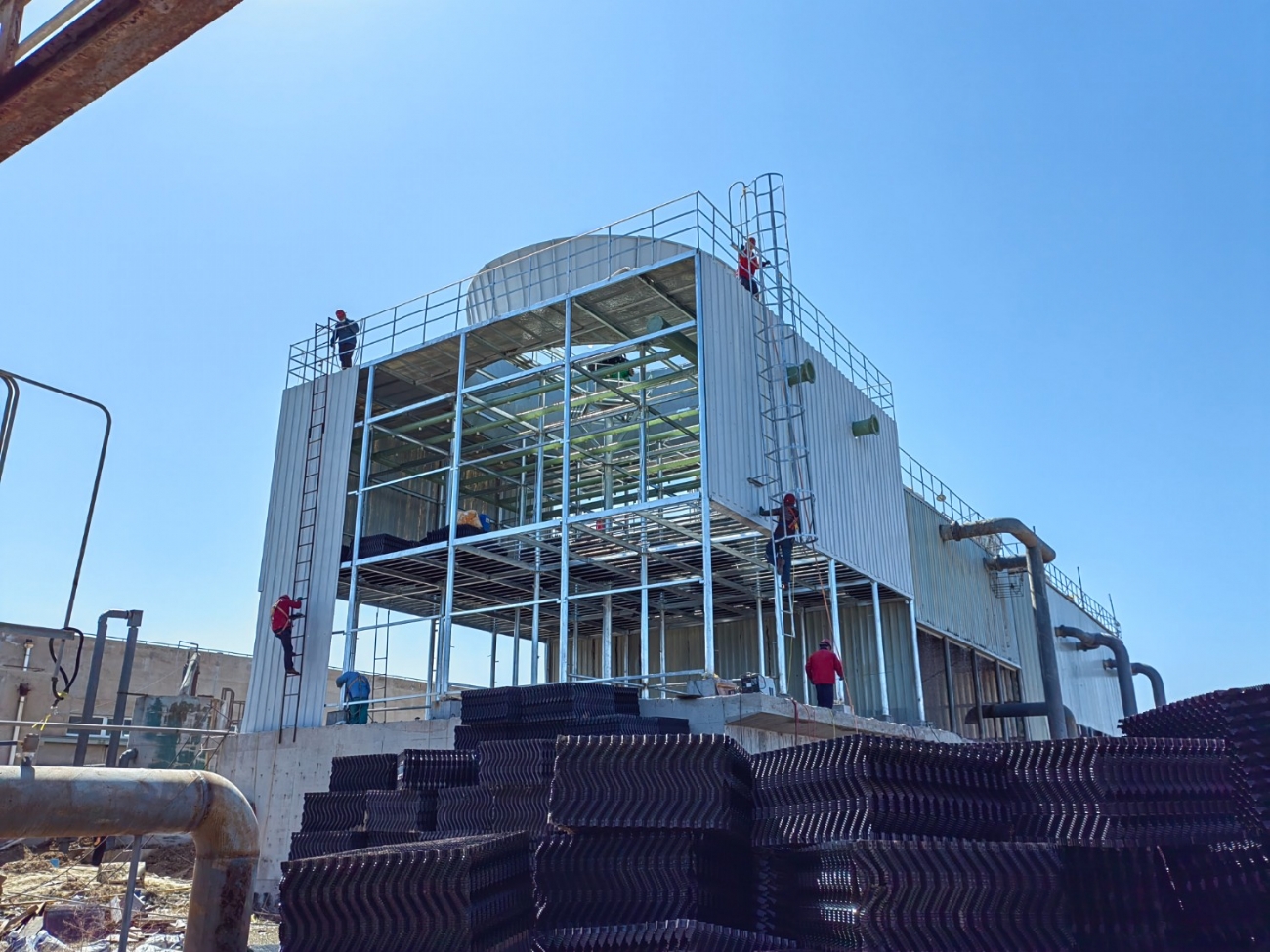
II. Full Comparison Across Key Performance Dimensions
Working from actual application requirements, the two types are compared quantitatively on heat exchange efficiency, energy consumption, water quality adaptability and operating stability. The specific differences are as follows:
1. Heat Exchange Efficiency: Spray Cooling Towers Lead with a Clear Cooling Range Advantage
The efficiency of a packed cooling tower depends on how well water films across the fill. Uneven water distribution, or fill that has aged or clogged, easily produces dead zones and channeling, which reduce the effective heat exchange area and degrade cooling performance. Its approach, the outlet water temperature minus the wet-bulb temperature, is usually around 4 ℃ and is difficult to improve further.
The atomized droplets in a spray cooling tower have a far greater specific surface area than the water film or droplets on a fill surface, and the air-to-water ratio can reach 1.0-1.3, against a figure usually below 1.0 for a packed tower, so heat exchange is more complete. Practice has shown that under the same operating conditions a spray cooling tower achieves a cooling range at least 2 ℃ wider than a packed tower and holds its approach within 3 ℃, maintaining stable cooling even in hot and humid conditions.
2. Energy Cost: Spray Cooling Towers Save Over 30% Energy and Cost Less to Run
The fill in a packed cooling tower creates considerable air resistance. To maintain airflow, a high-power fan motor is needed to overcome that resistance, and the water distribution system also requires a certain water pressure, so overall energy consumption is high. Mechanical losses in belt or gear drives add to the total.
Because the fill is removed, a spray cooling tower is essentially a hollow shell, and system resistance drops to less than half that of a packed tower. For the same airflow requirement, the matching fan motor capacity can fall to 60% of that of a packed tower. The low-pressure atomizing device also operates at only 0.035-0.25 MPa, far below the pressure of a packed tower water distribution system, so the power of the matching pump is greatly reduced. Taken together, a spray cooling tower consumes 30%-50% less energy than a packed tower, and the advantage in electricity cost over long-term operation is extremely significant.
3. Water Quality Adaptability: Spray Cooling Towers Resist Clogging and Cover More Applications
Packed cooling towers impose strict demands on water quality. Once the turbidity of the circulating water reaches 100 mg/L, the fill gaps and distribution nozzles tend to clog, causing uneven water distribution and restricted airflow, and cooling efficiency drops sharply. Industrial circulating water containing impurities or oil requires additional and complex pre-treatment, otherwise failures become frequent.
The atomizing nozzles of a spray cooling tower have a large bore, typically 10-30 mm, and no fill stands in the way, so resistance to clogging is excellent: the tower keeps running even at a turbidity of 200 mg/L. With no need for a water film to adhere to a fill surface, it also copes with harsh water containing oil, acids and alkalis, with no extra cost for water pre-treatment.
4. Operation and Maintenance: Spray Cooling Towers Are Maintenance-Free and Last Longer
The fill in a packed cooling tower ages, deforms and turns brittle, and its surface readily breeds bacteria and algae that call for regular treatment, so the fill usually has to be replaced every 3-5 years. The distribution nozzles also clog or get knocked off easily and need frequent dismantling, cleaning and repair, making the maintenance workload heavy and expensive. Clogged fill also adds to the load on the tower structure, which can damage the tower casing and shorten the service life of the equipment.
With no fill and no vulnerable distribution parts, a spray cooling tower completely removes the problems of fill aging, clogging and nozzle failure, and delivers stable operation that is free of blockage and free of repair. Its atomizing device is made of wear-resistant and corrosion-resistant polymer materials with a long service life, and the whole tower can last 15-20 years, more than three times that of a packed tower. With no periodic cleaning or fill replacement, it also saves a great deal of maintenance labor and material cost every year.
5. Structure and Installation: Spray Cooling Towers Are Lighter and Cheaper to Build
A packed cooling tower has to carry the weight of its fill, so the tower needs a large number of support beams and panels, making the civil structure complex and the footprint large. A fiberglass structure is light but poor in environmental terms and ages easily, while a reinforced concrete structure means heavy initial investment and a long construction period.
Spray cooling towers adopt a modular design with a simplified tower structure, weighing only 60%-70% of a packed tower of the same capacity. No complex support structure is needed, which substantially saves civil investment. The modular design also makes transport, installation and commissioning easier, shortening the construction period by more than 20% compared with a packed tower, which is particularly valuable on restricted sites or in retrofit projects.
III. Key Application Advantages and Suitable Scenarios for Spray Cooling Towers
The comparison above shows clear advantages in energy consumption, efficiency, maintenance and adaptability, and spray cooling towers are especially suited to the following scenarios:
1. Energy-intensive industrial applications with large water flow: in power generation, chemicals, metallurgy, pharmaceuticals and similar industries, the energy savings translate into significant cost reductions, while the wide cooling range meets the strict temperature requirements that industrial production places on circulating water.
2. Duties with poor water quality: circulating water systems carrying impurities, oil, acids or alkalis run stably without additional pre-treatment, avoiding the frequent clogging that troubles packed towers and keeping production continuous.
3. Restricted sites and retrofits of existing systems: the modular structure occupies more than 20% less floor area and weighs less, so it can replace an existing packed tower directly without large-scale modification of the civil foundation, shortening the retrofit and lowering its cost.
4. Sites with strict noise and environmental requirements: for air conditioning cooling systems near residential areas, hospitals and schools, spray cooling towers remove strong noise sources such as motors and gear reducers, so noise is lower. They also avoid the solid waste generated by fill replacement, which better meets environmental requirements.
IV. Conclusion: Selection Advice and Future Trends
Packed cooling towers are mature, traditional equipment and still have some relevance in civil or light-duty applications with clean water, small flow rates and limited budgets, but their limitations are increasingly apparent where industry needs energy savings and stable operation. With the core advantages of better heat exchange, lower energy consumption, no maintenance and wide adaptability, spray cooling towers are steadily becoming the preferred solution for industrial cooling systems.
For an enterprise, choosing a cooling tower means weighing its own water quality, water flow, cooling range requirements, site conditions and budget. Where long-term operating benefits matter, or where water quality is poor and energy consumption high, a spray cooling tower is the more cost-effective option. For small civil projects with clean water and a limited budget, a packed cooling tower remains worth considering.
Looking ahead, as the demands for energy savings and environmental protection continue to rise, spray cooling towers will replace older equipment in more industries on the strength of their technical advantages, driving industrial cooling systems toward greater efficiency and sustainability.








 Home
 Products
 Phone