In industries such as power generation, chemicals and metallurgy, the circulating water cooling system is the core equipment that keeps production running continuously, and the counter flow natural draft cooling tower has become the choice of many companies thanks to its advantages in heat exchange and energy savings. Relying on the natural convection of air to transfer heat, this type of equipment not only fits the concept of green production but also adapts to complex operating conditions, and its technical features and application value deserve a closer look.
The core advantage of a counter flow natural draft cooling tower comes from its unique heat exchange design. Unlike conventional cooling equipment, it works on a counter flow pattern in which water moves downward and air moves upward. Hot water is sprayed evenly over the fill by the water distribution system at the top of the tower, forming a fine water film or droplets, while cooler air is drawn naturally through the air inlet louvers at the base of the tower by the difference in air density between the inside and the outside, then travels upward through the fill and makes full contact with the hot water. This counter flow contact keeps the temperature difference between air and water consistently large, removing the maximum amount of heat through both sensible heat exchange and the latent heat of water evaporation. Cooling efficiency is significantly higher than that of a crossflow cooling tower, and the outlet water temperature can be held within a better range.
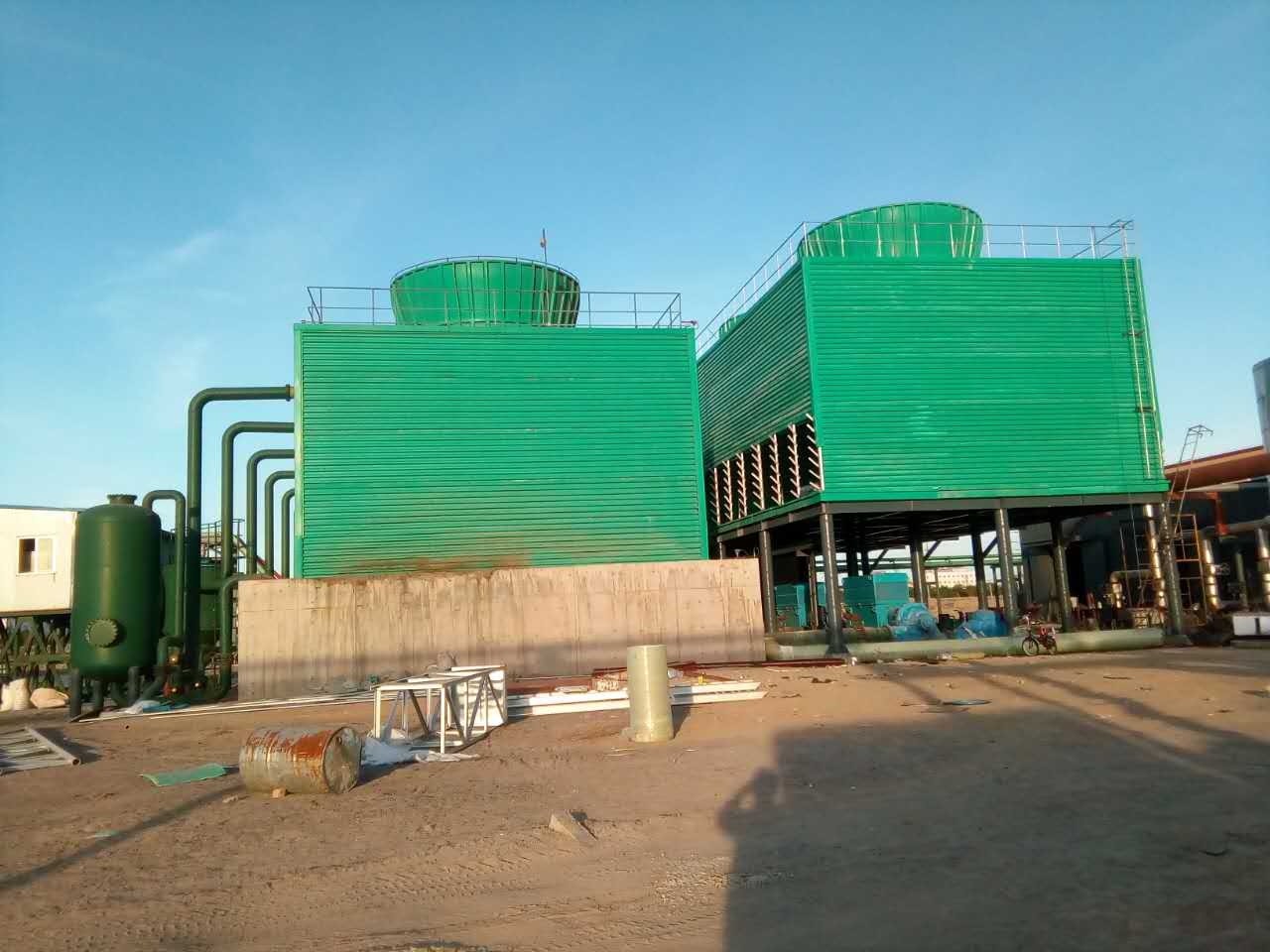
A well-conceived structure is the basis of stable operation. The tower casing is usually built as a hyperbolic reinforced concrete shell or from fiberglass, combining strength with corrosion resistance. The fill, as the heart of the heat exchange, uses a honeycomb or corrugated structure that greatly increases the contact area between water and air. The drift eliminator at the top of the tower uses an S-shaped profile to intercept water droplets carried by the air stream, keeping drift loss extremely low and saving water. The whole system needs no forced-draft fan and runs on natural ventilation alone, fully complying with national standards for energy savings and environmental protection such as GB/T 7190.1-2018.
In industrial applications its advantages are especially clear. First, a small footprint: for the same cooling capacity it occupies only 60%-70% of the horizontal area of crossflow equipment, which suits industrial parks where land is tight. Second, low operating cost: the natural draft design cuts energy consumption by more than 30% compared with mechanical draft cooling towers, and the low risk of water contamination reduces maintenance costs. Third, strong adaptability: it can handle hot water above 50 ℃, and with anti-freezing design it runs stably in cold regions. It is widely used for condenser cooling in thermal power plants, reactor cooling in chemical plants and similar duties.
As industry moves faster towards green transformation, the range of applications for counter flow natural draft cooling towers keeps expanding. Whether cooling a data center or recovering waste heat in a steel plant, they deliver energy-saving performance that helps companies cut production costs and meet their environmental responsibilities. Choosing a counter flow natural draft cooling tower that meets industry standards is without doubt the right solution for an industrial cooling system.








 Home
 Products
 Phone