Against a backdrop of increasingly tight industrial water supplies and ever stricter environmental requirements, closed cooling towers have become an important choice for companies seeking to optimize their cooling systems and run greener operations, thanks to their remarkable water-saving performance. So how exactly does a closed cooling tower save water, and how does its principle differ from that of an open cooling tower? This article takes a detailed look.
1. Closed Circulation Isolates the Loop, Eliminating Water Contamination and Blowdown Waste
The fundamental water-saving principle of a closed cooling tower lies in its "closed-loop circulation" design. Unlike an open tower, where the cooling water comes into direct contact with air, the process cooling water or process medium in a closed tower flows inside a completely sealed coil and never meets outside air. This delivers two major water-saving benefits:
Minimal contamination, no frequent blowdown: because the cooling medium circulates inside sealed piping, dust, impurities and microorganisms in the air cannot enter the system, and water quality stays clean and stable over the long term. The system therefore has little need for the heavy periodic blowdown required to remove contaminants, which fundamentally reduces the volume of fresh makeup water needed to offset blowdown losses.
Zero splash loss: the sealed piping completely eliminates the escape of water droplets carried out by wind or splashing that occurs in open towers, keeping all circulating water strictly inside the system.
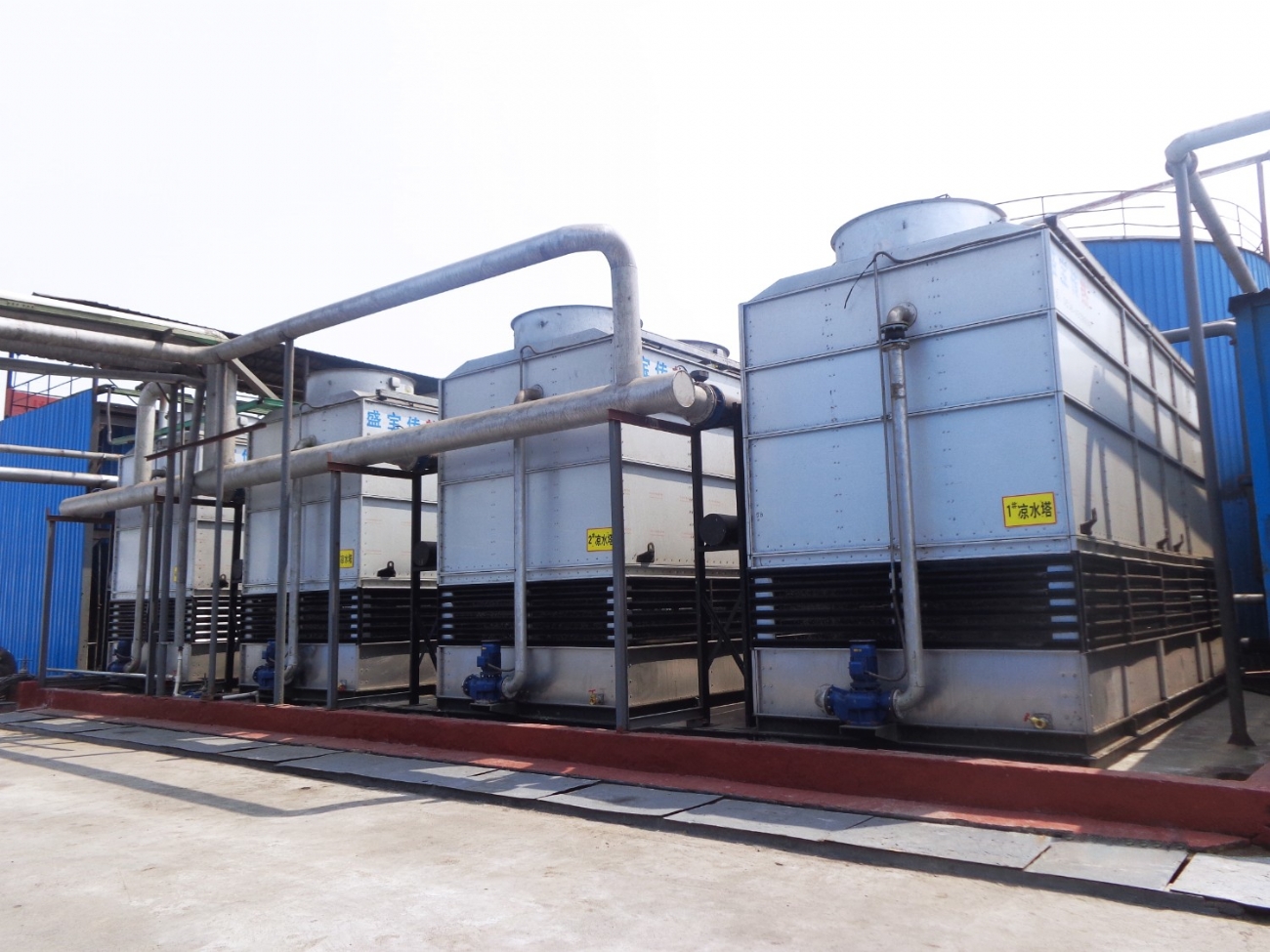
2. Multi-Dimensional Drift Eliminators Greatly Reduce Evaporation and Drift Losses
Although the main circulating water in a closed tower is sealed, part of its heat rejection still depends on the evaporation of external spray water on the coil surface. During this process a small amount of spray water is carried away by the air stream, which is known as drift loss.
Our closed cooling towers use multi-dimensional drift eliminators. Their multi-stage, multi-angle corrugated plate design separates water from the hot, humid air just before it is discharged. The device effectively captures the tiny droplets carried in the air stream and returns them to the basin, holding the drift rate strictly below 0.001%. Compared with conventional equipment, this almost negligible drift loss saves a large volume of makeup water over long periods of continuous operation.
3. Intelligent Variable Frequency Control, On-Demand Spraying to Cut Wasteful Evaporation
The spray system of a closed cooling tower does not run at full load all the time. When the ambient wet-bulb temperature is low or the cooling load falls, the amount of evaporative heat rejection required falls accordingly.
Our products are equipped with an intelligent control system that automatically adjusts the operating frequency of the spray pump and the spray water volume according to real-time cooling demand and ambient conditions. While maintaining heat exchange efficiency, it minimizes unnecessary spray evaporation, achieving on-demand water supply and more refined management of water consumption.
4. Stable Water Quality Extends Cycles and Indirectly Reduces System Water Use
Because the main circulating water system is sealed and clean, and the external spray water is used only for heat exchange and is only lightly contaminated, water quality management across the whole system becomes much simpler. This means:
The dosing interval for cooling water treatment chemicals can be greatly extended.
System cleaning frequency and the associated drainage are reduced, because water quality no longer deteriorates.
Spray water can be recirculated inside the tower, and only the small amount lost to evaporation and minimal drift has to be replaced, so makeup water consumption is significantly lower than with the conventional evaporative cooling of an open tower.
Building a Sustainable Industrial Water-Saving Solution
In summary, closed cooling towers rely on "closed circulation to isolate contamination, drift elimination, intelligent on-demand water supply, and stable water quality to reduce blowdown" a four-in-one combination of technologies that creates an intelligent water-saving system. It not only cuts the consumption of fresh water directly, but also eases both water costs and environmental pressure by reducing wastewater discharge, fully in line with national policies that promote the intensive and efficient use of water resources.
Choosing a water-saving closed cooling tower is not only a smart decision for lowering operating costs, it is also a concrete way to fulfil social responsibility and put sustainable development into practice. We will continue to apply innovative technology to help customers in every industry achieve greener and more economical production.








 Home
 Products
 Phone