Industrial open cooling towers are the most widely used type of cooling equipment. They cool process circulating water to the required temperature through evaporative heat exchange by direct contact between water and air. With a simple structure, moderate cost and easy maintenance, open cooling towers dominate large-flow cooling applications in power generation, chemicals, metallurgy, refrigeration and similar fields. In actual operation, however, many companies face problems such as declining cooling efficiency, high energy consumption and frequent scaling. Drawing on more than a decade of experience in cooling tower design and manufacturing, Shandong Shengbao Heat Transfer Technology Co., Ltd. systematically explains the key strategies for improving the operating efficiency of open cooling towers.

I. Working Principle of Open Cooling Towers and Factors Affecting Efficiency
The core heat exchange mechanism of an open cooling tower has two parts: evaporative cooling, which contributes 70%-80% of the heat transfer, and sensible heat exchange, which contributes 20%-30%. Hot circulating water is sprayed from the water distribution system at the top of the tower onto the fill surface to form a water film; driven by the fan, air passes through the fill from bottom to top in counter flow or horizontally in crossflow, contacting the water film and transferring heat.
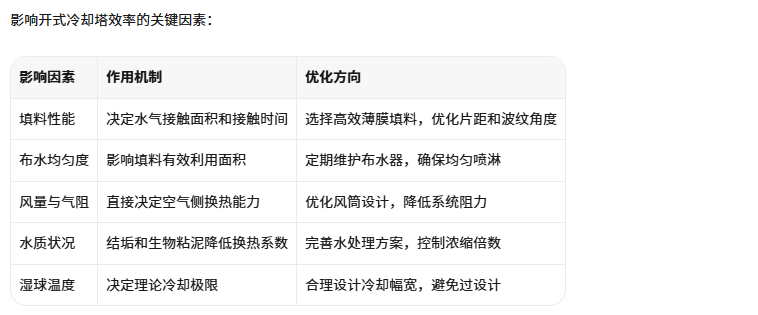
Key factors affecting open cooling tower efficiency:
II. Shengbao's Technical Solutions for Optimizing Open Cooling Tower Efficiency
Founded in 2012 and located in Anqiu, Weifang, Shandong, Shandong Shengbao Heat Transfer Technology Co., Ltd. has a registered capital of 120 million yuan and holds more than 140 patented technologies, forming a complete technical system for efficiency optimization in the field of open cooling towers.
1. CFD-Based Airflow Field Optimization
Conventional cooling tower design relies on empirical formulas and test corrections, which makes it difficult to optimize the complex airflow field inside the tower. Shandong Shengbao Heat Transfer Technology has introduced CFD (computational fluid dynamics) technology to numerically simulate the air flow field inside the tower, identifying vortex zones, short-circuit zones and stagnant zones, and then optimizing the air inlet louver, drift eliminator, fan stack and other structures accordingly, raising effective air volume utilization by more than 10%.
2. Composite Fill
The fill is the"heart" of an open cooling tower, and it directly determines heat exchange efficiency. The composite corrugated film fill independently developed by Shandong Shengbao Heat Transfer Technology uses a variable spacing design, dense at the top and sparse at the bottom, to match the water film distribution pattern, raising the overall heat exchange efficiency of the fill by 15% compared with conventional equal-spacing fill. The fill is made of PVC or PP, withstands temperatures up to 80 ℃, and has a service life of 8-10 years.
3. Variable Frequency Fan Energy-Saving System
Fans in conventional open cooling towers usually run at fixed speed and keep working at full load even in low-load seasons such as winter or at night, causing substantial energy waste. Shandong Shengbao Heat Transfer Technology fits variable frequency fan control systems as standard, automatically adjusting fan speed according to the outlet water temperature:
Summer high-temperature period: the fan runs at full speed to deliver full cooling capacity. Spring and autumn transitional seasons: the fan slows down, reducing energy consumption by 40%-60%. Winter low-temperature period: the fan runs at low speed or intermittently to keep the water temperature from falling too low.
The comprehensive annual energy saving rate can reach 25%-35%, with a payback period usually of 1-2 years.
4. Integrated Intelligent Water Treatment Solution
Water quality management is the key to keeping an open cooling tower running reliably over the long term. Shandong Shengbao Heat Transfer Technology provides an integrated intelligent water treatment system, including:
Online water quality monitoring (pH, conductivity, turbidity); automatic chemical dosing system (scale inhibitor, corrosion inhibitor); automatic blowdown control based on cycles of concentration; side-stream filtration to remove suspended solids.
This solution keeps the cycles of concentration of the circulating water effectively within 4-6, slows scaling and corrosion rates, and maintains stable heat exchange efficiency over the long term.
III. Methods for Diagnosing Open Cooling Tower Operating Efficiency
For cooling tower systems already in operation, regular efficiency diagnosis is recommended:
Cooling capacity test: measure the inlet and outlet water temperature difference, water flow rate, ambient temperature and humidity, and calculate the deviation of actual cooling capacity from the design value. Fill condition assessment: check the scale thickness on the fill, the coverage of biological slime, deformation and damage. Water distribution uniformity check: observe the water film distribution on the fill surface and check for dry zones or ponding. Fan performance test: measure air volume and air pressure, compare them with the nameplate values, and assess fan efficiency degradation. Water quality analysis: full water quality testing to evaluate the effectiveness of the water treatment program.
Shandong Shengbao Heat Transfer Technology provides cooling tower operating efficiency diagnostic services and issues a detailed diagnostic report together with an optimization proposal.
IV. A Typical Optimization Case
A chemical company's two existing open cooling towers, after 5 years of operation, had lost about 20% of their cooling efficiency, with the outlet water temperature 3-5 ℃ above the limit, affecting production. After an on-site diagnosis by the technical team of Shandong Shengbao Heat Transfer Technology, the following optimizations were implemented:
Replacing the original fill with composite fill, increasing the heat exchange area by 15%; upgrading the water distribution system, raising distribution uniformity from 78% to 95%; installing a variable frequency fan system, cutting fan energy consumption by 30%; implementing an online water treatment program, holding the cycles of concentration of the circulating water steadily at 5.
After the retrofit, the outlet water temperature of the cooling tower returned to the design value, annual fan energy consumption fell by 28%, and the payback period was 1.3 years.
The operating efficiency of an open cooling tower directly affects the stability and energy cost of industrial production. Through a combination of fill upgrades, airflow field optimization, variable frequency control and automatic water treatment, it is possible to restore cooling capacity and reduce energy consumption at the same time. Backed by more than a decade of technical expertise and over 140 patents, Shandong Shengbao Heat Transfer Technology Co., Ltd. provides customers in every industry with full life-cycle efficiency management solutions for open cooling towers. To learn more about our optimization solutions or schedule an on-site diagnosis, please contact the technical team at Shandong Shengbao Heat Transfer Technology.








 Home
 Products
 Phone