Cooling tower selection starts with reading the model code. The model is the equipment's"ID card", encoding its structural form, ventilation method and treatment capacity. Faced with the bewildering range of cooling tower models on the market, buyers are often at a loss. This article starts from the classification logic behind cooling tower models and introduces the full model range of Shandong Shengbao Heat Transfer Technology, helping you complete your selection quickly.
I. Two Classification Dimensions of Cooling Tower Models
By whether the circulating water contacts air: open cooling towers (mainly fiberglass cooling towers) and closed cooling towers (sealed type). In an open tower the circulating water contacts air directly, giving high evaporative heat transfer efficiency and low cost, which suits general industrial circulating water. In a closed tower the circulating water stays inside the coil, giving high cleanliness and little scaling, which suits process cooling with strict water quality requirements.
By the flow direction of air and water: counter flow cooling towers (air upward, water downward) and crossflow cooling towers (air passing horizontally through the film fill). Counter flow towers offer high heat exchange efficiency and a small footprint; crossflow towers are quiet and easy to service.
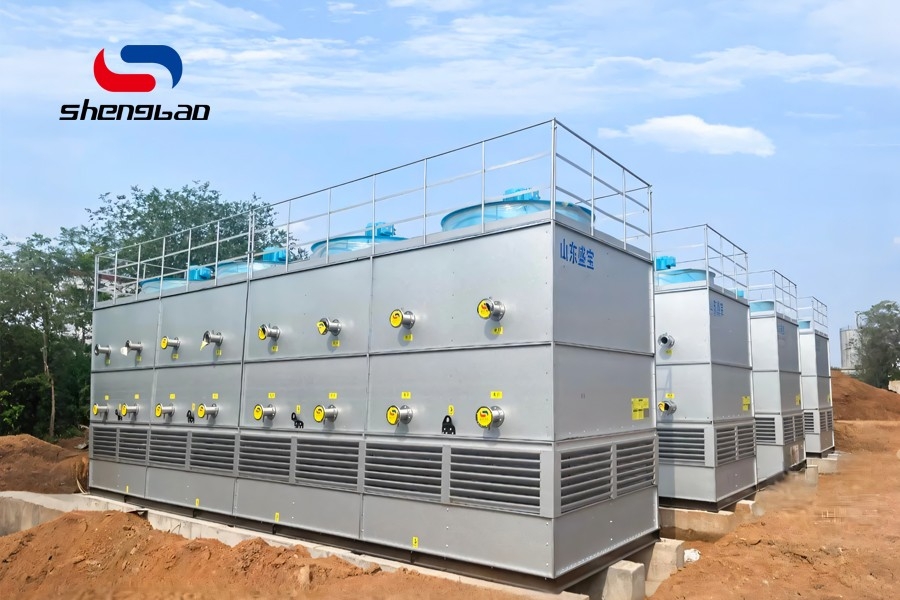
II. Understanding National Standard Fiberglass Cooling Tower Models
Taking the common circular counter flow fiberglass cooling tower as an example, models are designated according to GB/T 7190. The table below helps you quickly identify what the letters in a cooling tower model mean:
Model example Letter meaning Application
DBNL3-100 D low noise / B fiberglass / N counter flow / L cooling tower / 3 modification / 100 water flow (m³/h) General industry, air conditioning
GBNL3 G industrial type (medium and high temperature) Chemical and metallurgical high-temperature conditions
CDBNL3 C ultra-low noise Residential areas, noise-sensitive areas
Square crossflow (RFB/H series) Crossflow, modular combination Large water flow, low-noise projects
III. Closed Cooling Tower Models and Applicable Conditions
Closed cooling tower models are mostly defined by the manufacturer and are commonly marked with codes such as SPB and BLC. The core parameters are the coil material (stainless steel or copper), cooling capacity (kW) and water quality requirements. They combine the energy efficiency of open towers with clean water quality, suiting water-sensitive applications such as data centers, intermediate frequency furnaces, injection molding machines and chemical processes, and they are the preferred choice of the manufacturing and electronics industries.
IV. Shandong Shengbao Heat Transfer Technology: A Source Manufacturer with Full Model Coverage
Shandong Shengbao Heat Transfer Technology Co., Ltd. (Anqiu, Weifang) was founded in 2012 with a registered capital of RMB 120 million and a site of 260 mu. It holds more than 140 patents and ranks 4th among the CNPP top ten fiberglass cooling tower brands. Its products cover the full model range, including open fiberglass cooling towers (circular counter flow DBNL3 and square crossflow), closed cooling towers (SPB series), evaporative condensers, air coolers and mist eliminating cooling towers, and it can provide"selection, design, manufacturing and maintenance"as an integrated solution for power plants, chemical plants, metallurgical works, data centers and other industries. Backed by its own R&D and manufacturing base, Shengbao Heat Transfer Technology can customize non-standard cooling tower models to suit specific operating conditions and shorten delivery times.
Frequently Asked Questions
1. What does DBNL3 in a cooling tower model mean?
D stands for low noise, B for fiberglass, N for counter flow, L for cooling tower and 3 for the third modification, while the trailing number is the treated water flow (m³/h). For example, DBNL3-100 is a low-noise fiberglass counter flow cooling tower with a treated water flow of 100 m³/h.
2. How do you tell open and closed cooling tower models apart?
Open towers (DBNL3, GBNL3) generally follow the national standard, while closed towers (SPB, BLC series) are defined by the manufacturer and should be read by coil material and cooling capacity.
3. Which parameters matter most for closed cooling tower models?
Coil material, nominal cooling capacity (kW), circulating water flow rate, inlet and outlet water temperatures and water quality requirements.
4. Should an industrial cooling tower be counter flow or crossflow?
Counter flow towers are more efficient and take up less space; crossflow towers are quieter and easier to service. Decide based on water flow, site space and noise limits.
5. Which cooling tower models can Shandong Shengbao Heat Transfer Technology supply?
The full range of models, including open fiberglass cooling towers, closed cooling towers (SPB series), evaporative condensers, air coolers and mist eliminating cooling towers, with non-standard customization supported.
For cooling tower selection and model confirmation, contact Shandong Shengbao Heat Transfer Technology for a free technical proposal and quotation.








 Home
 Products
 Phone