In building an industrial cooling system, open cooling towers and closed cooling towers are the two most widely used types of cooling equipment. Many companies struggle to tell the difference between them and select on price alone, which easily leads to poor water quality, scaling, excessive energy consumption and shortened equipment life, seriously affecting the stability of the production line. As a source manufacturer of cooling towers, Shandong Shengbao Heat Transfer Technology breaks down the core differences between the two types across structural principles, operating performance, suitable conditions and maintenance costs, helping companies select the right unit and control costs sensibly.
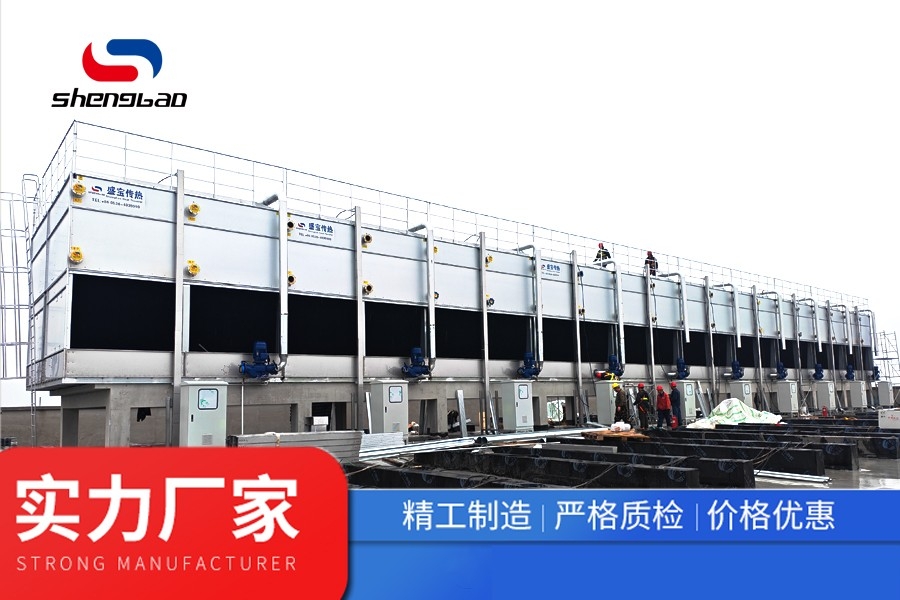
The first difference is fundamental, in core structure and working principle. An open cooling tower has an open structure in which the circulating water exchanges heat by direct contact with outside air: water is sprayed over the fill to cool down, and the water vapor convects directly with the air. The structure is simple and straightforward. A closed cooling tower, by contrast, uses a fully sealed circulation system with copper heat exchange coils inside, so the process circulating water flows entirely within the pipes and never contacts outside air, dust or dirt; heat is rejected only by external spray water, keeping the process water separate from the spray water. This is the biggest core difference between the two types.
Second, the gap in water quality maintenance and anti-scaling performance is clear. In an open cooling tower, the water circuit runs open, so dust, willow catkins, debris and corrosive gases in the air easily enter the water. Over time this breeds algae and sludge, and heavy scaling builds up in the piping and fill, which not only reduces heat exchange efficiency but also blocks the pipes, forcing frequent water changes and cleaning. A closed cooling tower runs sealed throughout, so the circulating water stays free of contamination with zero ingress of impurities, eliminating scaling and water quality deterioration at the source; no frequent water treatment is needed, and stable heat exchange performance is maintained over the long term.
In terms of suitable conditions and application scenarios, the two types each have their own focus. Open cooling towers have a low initial investment and suit general manufacturing, commercial air conditioning and ambient-temperature cooling, where there is no cleanliness requirement and conditions are simple, adapting well to basic duties with modest demands on temperature precision and equipment stability. Closed cooling towers suit harsh and complex conditions; with their corrosion resistance and cleanliness, they are widely used in chemicals, pharmaceuticals, new energy, metallurgy, precision manufacturing, data centers and similar applications, tolerating high temperatures and acid or alkali corrosion and supporting 24-hour continuous operation.
There is also the difference in energy consumption and long-term maintenance cost. Open cooling towers lose a large amount of water to drift, so water consumption is high, and once scaling sets in, heat rejection efficiency keeps declining while energy use climbs year by year, leaving maintenance costs for repairs, fill replacement and water changes persistently high. Closed cooling towers stand out for water and energy savings, with extremely low water loss, stable copper coil heat exchange efficiency that resists degradation, low failure rates and a longer service life; although the initial purchase cost is slightly higher, their overall long-term performance far exceeds that of open equipment.
In short, an open cooling tower is fine for ordinary, conventional conditions, while precision manufacturing, corrosive environments and continuous production should give priority to a closed cooling tower. For cooling tower selection, contact Shandong Shengbao Heat Transfer Technology: our engineers provide one-on-one condition matching and custom industrial cooling equipment with high adaptability and low maintenance.








 Home
 Products
 Phone