Redefining Tradition and Setting a New Standard for Energy-Saving Cooling
In the field of industrial cooling, energy consumption and operating costs remain constant concerns for enterprises. With continuous technological progress, an innovative cooling device, the spray-propelled cooling tower, is coming into its own. With its revolutionary design concept and outstanding performance, it offers a better cooling solution for a wide range of industries. The equipment not only breaks through the technical limitations of conventional cooling towers, but also stands out in energy savings, reduced maintenance and lower noise, making it an ideal choice for modern industrial cooling systems.
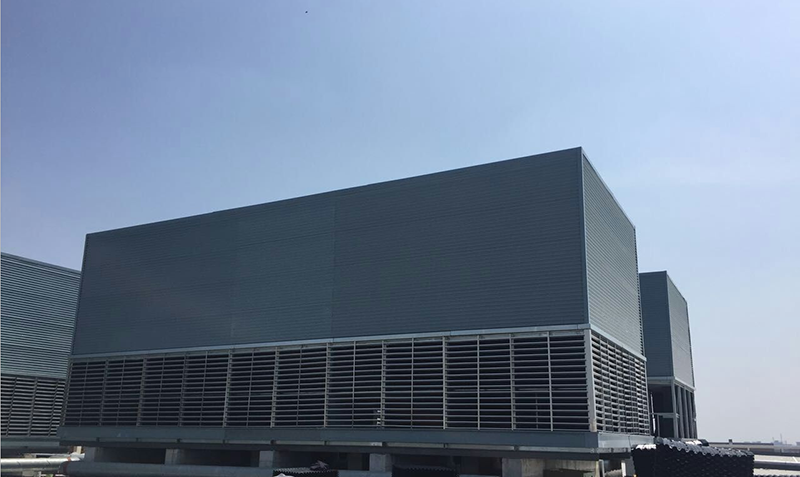
Technical principle: when spray becomes the power source
The design of the spray-propelled cooling tower abandons the conventional approach of a motor-driven fan and instead uses a high-pressure spray system as the driving force for air circulation. Its working process is ingeniously simple: after being pressurized by a high-pressure pump, the cooling water passes through specially designed nozzles that form an extremely fine, high-speed mist; the high-speed spray entrains the surrounding air, creating an air flow inside the tower that completes the heat exchange process.
The elegance of this innovative design lies in its dual benefits. On the one hand, micron-sized mist droplets greatly increase the contact area between water and air, making heat transfer faster and more complete. On the other hand, the air flow generated by the spray entirely replaces the conventional fan, eliminating the energy losses and failure risks associated with motors, transmissions and other mechanical components. This "spray instead of fan" concept is precisely where the energy savings of the spray-propelled cooling tower come from.
Six major advantages that reshape the value of cooling
Outstanding energy-saving performance
In conventional cooling towers, the fan motor often accounts for a large share of the total energy consumption. The spray-propelled cooling tower eliminates this energy-intensive component entirely, reducing overall energy consumption by 30% to 50%. Over the long term, these savings translate into significant economic benefits, especially for continuous operations and energy-cost-sensitive production sites.
Significant water savings
By optimizing atomization and air flow organization, the spray-propelled cooling tower achieves a more refined water-air exchange. Its unique structural design effectively reduces drift loss, saving 20% to 40% more water than conventional cooling towers. As water resources become increasingly scarce and water tariffs keep rising, this feature gives companies a greater competitive edge.
Environmentally friendly quiet operation
Without high-speed rotating fan blades, the noise level of the spray-propelled cooling tower is greatly reduced. This allows it to be installed in noise-sensitive areas such as urban industrial parks, near hospitals and around residential neighborhoods, where conventional cooling towers are restricted, broadening the range of locations where the equipment can be used.
Low maintenance requirements thanks to a simplified structure
The simplification of mechanical components translates directly into a lower failure rate and lower maintenance costs. Problems common in conventional cooling towers, such as fan failures, belt wear and bearing damage, no longer exist in a spray-propelled cooling tower. Companies can substantially reduce the frequency and cost of routine maintenance while lowering the risk of production interruptions caused by sudden equipment failure.
Compact design saves space
With the bulky fan system removed, the overall structure of the spray-propelled cooling tower is more compact and its footprint correspondingly smaller. This makes it especially suitable for retrofit projects with limited space or for new plants, allowing companies to achieve effective cooling even in a restricted area.
Enhanced environmental adaptability
The unique working principle of the spray-propelled cooling tower allows it to maintain good performance even in high-temperature and high-humidity environments, unlike conventional cooling towers, which are significantly affected by the ambient wet-bulb temperature. This broad environmental adaptability extends the geographical range of applications.
Conclusion: a cooling solution for the future
With its innovative design and technological advantages, the spray-propelled cooling tower brings new possibilities to industrial cooling. It not only resolves the high energy and water consumption of conventional cooling systems, but also reduces maintenance costs and failure risks through a simplified structure. For modern enterprises pursuing both production efficiency and sustainable development, choosing a spray-propelled cooling tower is not merely a technology upgrade, but a strategic investment.
As this technology continues to mature and market awareness grows, spray-propelled cooling towers are expected to play an important role in a wider range of industrial sectors, providing economical and environmentally friendly cooling solutions for different industries and helping companies achieve results in both energy conservation and cost control.








 Home
 Products
 Phone