Forced ventilation driven by a motor and fan has long been the mainstream approach for cooling towers. The spray-propelled ventilation cooling tower offers an alternative technical path: it removes the fan motor and converts the residual pressure already present in the circulating water system into the driving force for both atomization and ventilation. Known as a packing-free cooling tower, this type of equipment offers distinctive value in terms of energy savings and fewer mechanical failure points, and has been attracting growing attention in recent years in continuously operating circulating water systems in the chemical, metallurgical and thermal power industries.
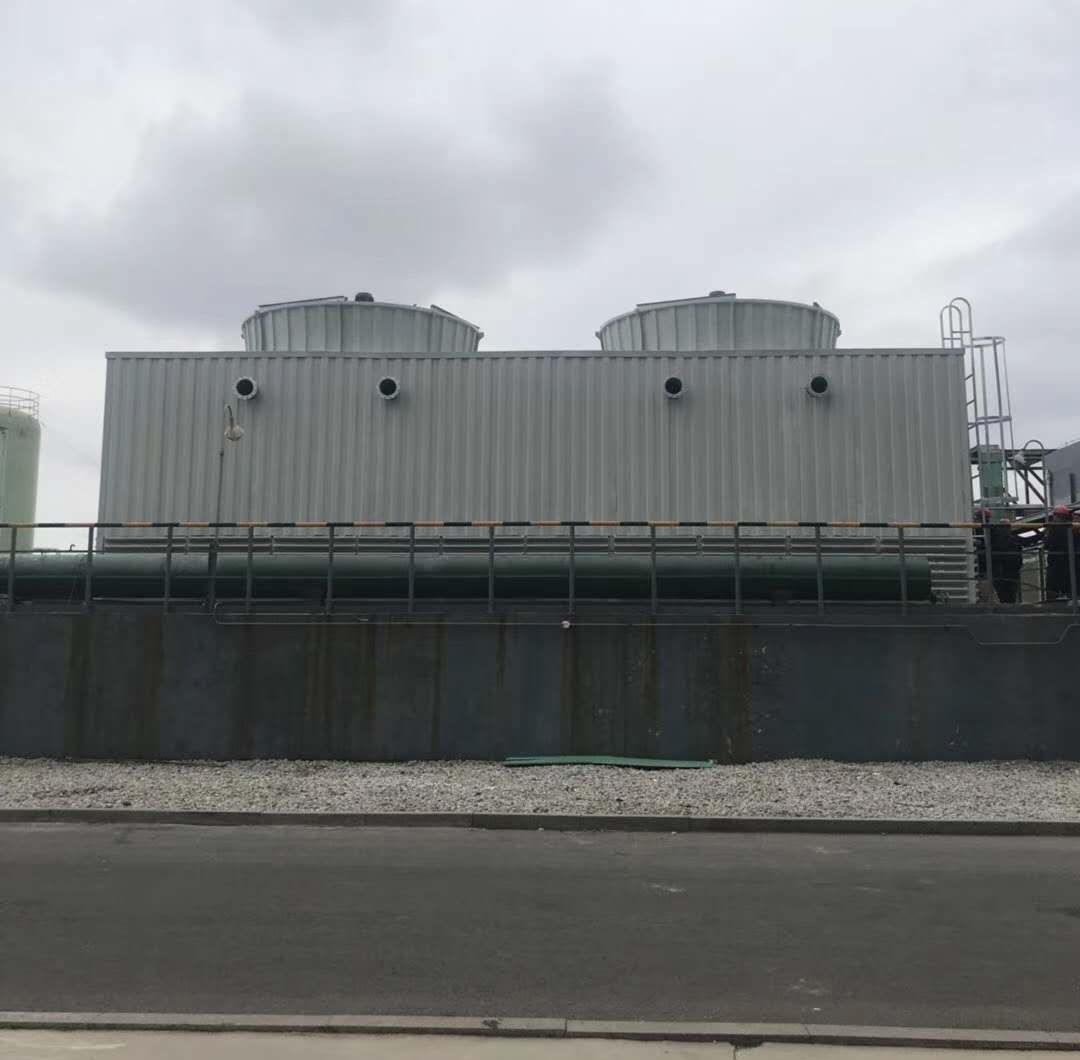
1. Core principle: replacing motor power with residual water pressure
The working logic of a spray-propelled ventilation cooling tower can be summed up in one sentence: let the circulating water draw in the air by itself.
A circulating water system always carries a certain amount of surplus pressure during operation. In a conventional packed tower, this residual pressure is largely consumed by friction loss along the distribution piping and by the spray nozzles. The spray-propelled cooling tower directs the cooling water into a purpose-designed atomizing device, where the pressurized flow is forced into rotation and ejected at high speed to form fine droplets. The reaction force of the jet simultaneously drives the device to rotate, creating a negative pressure zone inside the tower that draws outside air in through the air inlet face, pushes it upward through the tower body and finally discharges it from the fan stack at the top.
The entire process requires no fan motor, gear reducer or drive shaft, and there is no fill layer. Atomization of the water, the movement of air and heat and mass exchange are all completed within the same space. This is where the two descriptions of"packing-free"and"zero-electricity drive"come from.
2. Main components
Spray-propelled atomizing device: the core of the equipment, determining droplet size, spray angle and ventilation capacity; its hydraulic design must be matched to the head and flow rate of the circulating water pump. Drift eliminator: captures water droplets carried out by the rising air stream; its structural form directly affects drift loss and makeup water rate. Tower body and water collection system: the tower body is mostly of fiberglass or steel frame construction, with air inlet louvers on the air inlet side to reduce splashing, while the basin collects the returning water and is fitted with water quality conditioning and blowdown connections.
3. How it compares with conventional packed towers
Power consumption structure. In a conventional tower, power consumption is concentrated in the fan motor and the circulating water pump. A spray-propelled tower eliminates the fan motor, but the circulating water pump must supply sufficient residual pressure, so the pump shaft power may increase accordingly. The actual energy saving depends on the surplus pressure available in the existing pump and the resistance distribution of the pipe network, and must be measured before a retrofit rather than estimated from equipment parameters alone.
Distribution of maintenance workload. In a conventional tower, mechanical failure points are concentrated in the motor, gear reducer, belts, bearings and fan blades. A spray-propelled tower eliminates these components, but the atomizing device is a hydraulic component, and nozzle wear, scaling and clogging affect both atomization quality and ventilation capacity, which makes water quality management even more important.
Sensitivity to clogging and scaling. The fill layer is the main place where scale, biological slime and impurities accumulate, and it has to be shut down and pulled out for replacement at the end of every service cycle. A packing-free structure removes this accumulation zone and adapts better to circulating water with high dust content and suspended solids, but the nozzles become the new sensitive point, requiring side-stream filtration and regular inspection.
4. Project conditions where it is and is not suitable
Situations where the value is easily realized: ample residual pressure in the circulating water system and low pipe network resistance; long annual operating hours and high electricity tariffs; circulating water with high dust or suspended solids content causing frequent fill clogging; noise requirements that call for fewer fan and drive system noise sources.
Situations requiring careful evaluation: insufficient surplus pressure at the circulating water pump, making a higher pump head necessary; a demanding outlet water temperature approach combined with limited tower space; extremely hard water without adequate water treatment; and parallel operation with existing packed towers where water distribution and water level balancing are difficult to stabilize.
5. Key points in selection and operation
Hydraulic matching is the prerequisite. The actual flow rate, head and pipe network resistance of the circulating water pump under operating conditions should be measured first, and the model and number of atomizing devices determined accordingly.
Water quality management. A side-stream filter is recommended to control suspended solids, and scale and corrosion inhibitors should be dosed according to water analysis results to keep the cycles of concentration under control. A strainer is advisable at the nozzle inlet.
The condition of the drift eliminator affects makeup water consumption. Deformed, damaged or fouled drift eliminator blades increase drift loss, so they should be included in the regular inspection checklist, and the trend of makeup water consumption should be recorded as a basis for judgement.
Cell-by-cell layout facilitates maintenance. When several cells operate in parallel, inlet and outlet valves should be provided for each cell so that a single cell can be isolated for maintenance. In addition, the large contact area between the droplets and cold air in a packing-free tower creates a risk of freezing in the basin, piping and atomizing device in winter, so projects in northern China need anti-freezing measures.
6. Frequently asked questions (FAQ)
Q: Is heat exchange in a packing-free cooling tower always weaker than in a packed tower?
A: No general statement can be made. Heat exchange is determined jointly by the water-air contact area, contact time and air velocity. A packing-free tower disperses the water into a large number of fine droplets through atomization, greatly enlarging the contact area, so the design outlet water temperature can be met when the tower height and air volume are properly matched. However, if the droplets are too large, atomization is uneven or air short-circuits inside the tower, performance drops significantly.
Q: What preliminary information is generally needed for a retrofit to a spray-propelled cooling tower?
A: At a minimum, the circulating water flow rate, inlet and outlet water temperatures, wet-bulb temperature, circulating water pump model and measured operating parameters, piping layout and estimated resistance, available site dimensions, annual operating hours and electricity tariff. Of these, the actual pump operating parameters and pipe network resistance are the core data for judging the potential for energy savings, and on-site measurement is recommended.
Q: What are the maintenance priorities for a packing-free cooling tower?
A: The focus shifts from mechanical components to hydraulic components. Routine checks should cover whether the spray pattern of the atomizing device is uniform, whether nozzles are clogged or worn, whether the drift eliminator is deformed or fouled, and whether the basin water level and makeup water rate remain stable.
Technical discussion on packing-free cooling towers
Founded in 2012, Shandong Shengbao Heat Transfer Technology Co., Ltd. is located in the Chengxi Industrial Park of Anqiu, covering an area of more than 180000 square meters, with registered capital of 120 million yuan, total investment of 260 million yuan and 58 technical staff, including 9 with doctoral or master's degrees or senior engineer titles. Its product line includes closed cooling towers, open cooling towers, fiberglass cooling towers, steel structure cooling towers, mist eliminating cooling towers, crossflow and counter flow cooling towers, spray-propelled ventilation cooling towers, spray-type packing-free cooling towers, turbine-driven cooling towers and energy-saving cooling tower retrofits. The company holds three-system certification, a safety production license and a special equipment production license, among other qualifications.
Whether a spray-propelled ventilation cooling tower is suitable depends on the residual pressure available in the circulating water system and on the space available on site, so we recommend a review of site conditions before deciding on a scheme. You are welcome to discuss your requirements with our technical team.www.shengbaochuanre.com








 Home
 Products
 Phone