Processes in the chemical industry are complex and demanding. The media involved are often corrosive, flammable and explosive, and the requirements placed on temperature control accuracy, water cleanliness and environmental compliance are extremely high. Conventional open cooling towers bring familiar pain points, namely easy scaling, heavy water consumption and contamination of the process medium, which seriously affect production safety and efficiency. With their core advantages of sealed circulation, corrosion resistance and long service life, energy and water savings and accurate temperature control, closed circulating water cooling towers fit the entire chemical production chain and have become essential auxiliary equipment for chemical companies that need to avoid safety risks, cut operating costs and produce in a green and compliant way. The following sections analyze their core applications and their value in the chemical industry.
In chemical production, the reliability of the cooling system is directly linked to process stability and production safety. The sealed design of closed circulating water cooling towers removes the industry pain points of conventional cooling equipment at the source. Adaptable to every kind of chemical operating condition, they cover multiple core production stages and reconcile practicality with compliance.
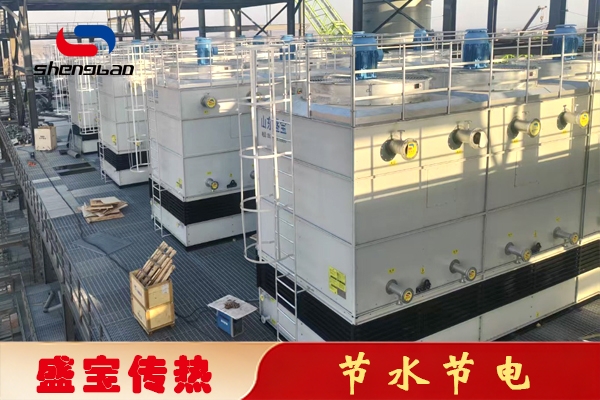
Core Process Stages: Fitting the Whole Chemical Flow
Serving as the cooling hub of chemical production, closed circulating water cooling towers are deeply integrated into every key stage, meeting the cooling needs of different processes in a targeted way and keeping production running continuously and steadily.
The chemical reaction stage lies at the heart of chemical production. All kinds of exothermic reactions require accurate temperature control, since any deviation easily produces by-products and triggers safety incidents. Closed circulating water cooling towers provide constant-temperature cooling for reaction vessels and reactors, with temperature control accuracy down to ±0.5 ℃. The sealed system completely prevents cooling water from contaminating the process medium and suits corrosive reaction environments as well: the tower casing is made of vinyl ester resin fiberglass, while the heat exchange coil is made of titanium alloy or 316L stainless steel according to the characteristics of the medium, effectively resisting corrosion by acids and alkalis and avoiding the risk of equipment leakage.
In distillation and separation, the closed cooling tower condenses the high-temperature vapor at the top of the distillation column, recovering useful waste heat while reducing the loss of organic solvents to volatilization and improving separation purity and efficiency. Its sealed nature prevents volatile media from coming into contact with air and oxidizing, and avoids both the environmental pollution and the safety hazards caused by media leakage, which is consistent with the requirements of the Technical Guidelines for Water Conservation and Pollution Prevention and Control of Industrial Circulating Cooling Water.
In fluid transfer and compression, reliable cooling of compressor lubricating oil and pump jacket water has a direct effect on equipment service life. Closed circulating water cooling towers control the cooling water temperature effectively and prevent equipment overheating and wear, while their advantage of controllable water quality avoids scaling and blockage in pipes, lowers equipment operation and maintenance costs, resolves the problems of energy efficiency decay and excessive redundancy seen in conventional cooling systems, and raises operating efficiency.
In waste heat recovery, closed cooling towers capture waste heat from process production and use it for preheating raw materials, heating workshops and similar purposes, realizing the cascade use of energy and helping chemical enterprises reduce energy consumption and pursue their dual carbon goals. This is also in line with the mandatory requirements of GB 30252-2024, Minimum Allowable Values of Energy Efficiency and Energy Efficiency Grades for Closed Cooling Towers, and improves corporate energy efficiency compliance.
Advantages Tailored to the Chemical Industry: Solving Its Core Pain Points
Compared with conventional cooling equipment, closed circulating water cooling towers are optimized for the specific characteristics of the chemical industry and offer three core advantages. The first is corrosion resistance and durability: apart from the careful selection of materials, the inner wall of the tower casing is coated with a polyurea anti-corrosion layer and components such as fans and nozzles are made of corrosion-resistant materials, so the tower can operate for the long term with media containing acids, alkalis and salts, extending equipment service life. The second is environmental compliance: drift loss stays below 0.01%, there is no visible white plume, and noise is held under 56 dB, meeting the requirements for boundary noise and fugitive emissions at industrial enterprises and getting through environmental acceptance with ease. The third is energy and water savings: the sealed circulation loop reduces water losses, saving more than 60% of the water used by a conventional open cooling tower, while the optimized heat exchange design lowers the energy consumption of fans and pumps, resolving the twin problems of high water and high energy consumption in the chemical industry.
In addition, closed circulating water cooling towers can be customized to the process requirements of chemical enterprises with modular designs and intelligent operation and maintenance systems, providing functions such as automatic water level monitoring and low water level alarm shutdown that reduce the cost of manual inspection. They can also be linked to the manufacturing execution system (MES) of a chemical enterprise, further raising the level of intelligent production.
In summary, closed circulating water cooling towers match the requirements of every core stage in the chemical industry. They eliminate the corrosion, contamination and high consumption problems of conventional cooling equipment and help enterprises reach the multiple goals of safe production, environmental compliance and energy savings. If you need a dedicated cooling solution tailored to a specific chemical process, whether fertilizers, refining or fine chemicals, please feel free to consult us. We will provide equipment solutions tailored to your process and compliant with regulations, supporting the high-quality development of chemical enterprises.








 Home
 Products
 Phone